
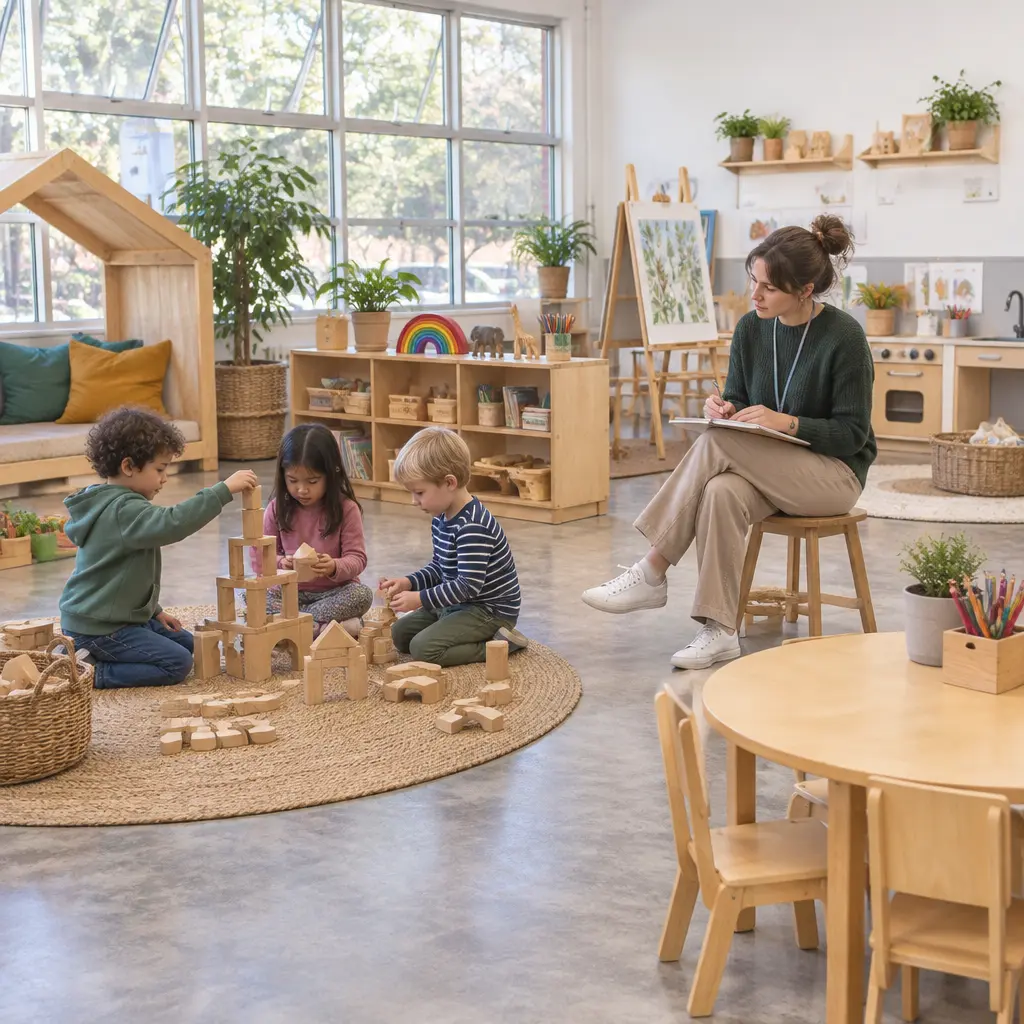
Early childhood developmental tracking is the ongoing process of observing and documenting how young children learn, communicate, move, and interact. Programs use a combination of everyday observations, developmental screening, family conversations, and—when needed—formal assessment to notice progress and identify possible support needs. The Centers for Disease Control and Prevention (CDC) reports that developmental monitoring helps families and professionals recognize when a child may benefit from further evaluation; screening is a distinct, more structured check. Together, these practices help educators plan responsive activities, partner with families, and connect children with timely services.
Developmental Progress Tracking in Early Childhood Programs: Purpose and Principles
Developmental progress tracking is the organized collection and interpretation of information about a child’s development over time. The National Association for the Education of Young Children (NAEYC) describes developmentally appropriate assessment as an ongoing process that supports teaching and learning, rather than a single test or a way to rank children. Programs typically consider physical, cognitive, communication, social-emotional, and adaptive development, while recognizing that children develop at different rates and that language, culture, disability, and opportunity can shape what is observed.
Tracking matters because early identification can lead to earlier support, while useful progress information helps educators adjust instruction before a child falls further behind. The CDC’s “Learn the Signs. Act Early.” materials emphasize monitoring developmental milestones and discussing concerns with a child’s health care provider. Milestones are useful prompts for conversation, not diagnostic tests or substitutes for validated screening. A program’s records should therefore inform decisions, not label a child.
Developmental domains and observable evidence
Developmental domains are connected areas of growth that educators use to organize observations. For example, a child’s ability to join a group activity may involve communication, social-emotional skills, attention, and self-regulation at once. Programs gather evidence from play, routines, conversations, work samples, and interactions—not just from adult-directed tasks. Recording what a child did and the context in which it happened makes an observation more useful than a broad judgment such as “behind” or “advanced.”
Individual variation and equitable interpretation
Developmental expectations are reference points, not fixed deadlines. Children who are learning more than one language, have disabilities, or have had different access to learning experiences may show skills in ways that a narrow assessment misses. NAEYC recommends using assessment practices that are appropriate to children’s ages, backgrounds, and languages. Programs can improve fairness by asking families how a child communicates at home, offering opportunities to demonstrate skills in familiar ways, and considering whether an apparent difficulty reflects the task or setting rather than the child’s ability.
Developmental Monitoring and Observation in Early Childhood Programs
Developmental monitoring is the repeated observation of a child’s growth and the sharing of those observations among caregivers and professionals. The CDC distinguishes monitoring from developmental screening: monitoring happens continually in everyday settings, while screening uses a formal tool to check whether development is generally on track or whether further evaluation may be warranted. In early learning programs, monitoring supplies the context that makes screening results and teaching decisions more meaningful.
Everyday observations and documentation
Educators document learning through brief anecdotal notes, dated photographs or work samples, checklists, and records of skills observed during routines. A useful note describes the behavior, setting, and support provided—for instance, whether a child independently followed a two-step direction during cleanup or did so after a visual cue. Repeated observations across people, activities, and days help distinguish a consistent pattern from a one-time event. Documentation should be securely stored and limited to information relevant to supporting the child.
Family partnership and contextual knowledge
Families contribute knowledge that educators cannot obtain from classroom observation alone, including a child’s interests, home language, routines, and skills shown in familiar settings. Two-way communication can take place through conferences, translated questionnaires, daily exchanges, or shared learning portfolios. When a concern arises, educators should describe specific observations, invite the family’s perspective, and agree on next steps. This collaborative approach reduces the risk of interpreting cultural or linguistic differences as developmental problems.
Portfolios and progress summaries
A portfolio brings together selected evidence over time, such as work samples, observation notes, and family contributions. A progress summary interprets that evidence in relation to learning goals or developmental expectations. Portfolios can make growth visible to children and families, but they are most useful when educators select evidence purposefully, include dates and context, and explain what the material shows. A collection of attractive samples without interpretation is not, by itself, a reliable assessment.
Developmental Screening and Assessment in Early Childhood Programs
Screening and assessment are related but distinct practices. Developmental screening is a brief, standardized check that identifies children who may need a closer look; it does not diagnose a condition. Assessment is broader: it may combine observations, interviews, work samples, and formal measures to understand a child’s strengths and needs and guide instruction or services. The American Academy of Pediatrics (AAP) recommends developmental surveillance at health visits and standardized developmental screening at specified ages, including 9, 18, and 30 months. Early childhood programs can coordinate with families and health professionals, while following applicable consent and privacy requirements.
Standardized developmental screening
A standardized screening tool uses consistent questions or tasks and established procedures to flag possible concerns. The AAP recommends autism-specific screening at 18 and 24 months in addition to general developmental screening. A positive screening result indicates that further evaluation may be appropriate; it is not a diagnosis. Screening works best when tools are appropriate for a child’s age and language, staff follow the instructions, families understand the purpose, and programs have a plan for referral and follow-up.
Ongoing formative assessment
Formative assessment is the continual use of evidence to guide next teaching steps. An educator might notice that a child sorts objects by color but not yet by shape, then offer varied materials and observe how the child approaches the challenge. This process links observation to planning and reassessment. Head Start’s framework for ongoing child assessment emphasizes using information about children’s skills and progress to individualize teaching and support learning goals.
Formal evaluation and referral
A formal evaluation is a more comprehensive assessment conducted by qualified professionals to determine whether a child may have a developmental delay or disability and what services could help. If monitoring or screening raises a concern, programs can share documented observations with the family, discuss referral options, and support contact with the child’s health care provider or local early intervention system. In the United States, the Individuals with Disabilities Education Act (IDEA) provides for early intervention services for eligible infants and toddlers under Part C and special education and related services for eligible children ages 3 through 21 under Part B. Eligibility and service procedures are determined through the relevant public systems, not by a classroom screening alone.
Using Developmental Progress Data to Improve Teaching and Support
Data become valuable when programs use them to make practical decisions. Educators can review evidence to identify emerging strengths, plan suitable challenges, adjust routines, and decide whether a child needs additional observation or a referral discussion. At the program level, aggregated information can reveal patterns—for example, whether children have consistent access to language-rich activities—without treating a group average as a verdict on any individual child.
Individualized learning plans and teaching adjustments
An individualized learning plan translates observed strengths and needs into specific, achievable teaching steps. A plan might set a goal for a child to communicate a choice using speech, gesture, pictures, or a communication device, then specify opportunities and supports for practicing that skill. Educators should revisit goals regularly and record whether a strategy is helping. This makes tracking a cycle—observe, interpret, plan, act, and review—rather than a paperwork exercise.
Program review and quality improvement
Program leaders can use de-identified, appropriately aggregated data to review curriculum, staff practices, and access to support. For example, if observations show that children have few opportunities to practice conversation during the day, leaders might revise schedules or coach staff in extending children’s talk during play. Results should be interpreted alongside classroom context and family input. Differences in recorded progress may reflect attendance, language access, tool selection, or observation practices—not only children’s development.
Confidentiality and responsible data use
Developmental records contain sensitive information. Programs should explain what is collected and why, obtain required permissions, limit access to people with a legitimate educational or service role, and use secure storage and transfer procedures. In the United States, privacy duties may depend on the program and the records involved, including requirements under the Family Educational Rights and Privacy Act (FERPA) or other applicable laws. Families should be able to understand how findings will be discussed and what steps may follow.
A Practical Example of Developmental Progress Tracking
Consider a preschool educator who notices that a child rarely joins peer conversations during free play. Rather than immediately concluding that the child has a communication delay, the educator records when the child speaks, what supports are present, and whether the child communicates through gestures, words, or another language. The educator asks the family how the child interacts at home and checks whether the classroom environment offers familiar play materials and enough time for conversation.
If observations continue to raise concern, the educator discusses them privately with the family and explains that a screening or professional evaluation could provide more information. Meanwhile, staff can offer small-group play, visual choices, and responsive conversation opportunities, then document whether these supports help. This example illustrates how monitoring, family knowledge, assessment, teaching adjustments, and referral can work together without treating one observation as a diagnosis.
Conclusion: Making Developmental Tracking Useful and Respectful
Effective developmental progress tracking combines everyday monitoring, careful documentation, family partnership, appropriate screening, and ongoing assessment. These practices help early childhood programs understand children’s strengths, adapt teaching, and connect families with further evaluation or services when needed. The central principle is to use evidence as a guide for support—not as a label or a comparison between children.
Programs can strengthen their approach by reviewing whether their tools are age- and language-appropriate, training staff to record objective observations, protecting confidential information, and ensuring that families know how to raise concerns and access follow-up. For further guidance, families and educators can consult the CDC’s developmental monitoring resources, the AAP’s developmental screening recommendations, and their local early intervention or school district system.
Sources: Centers for Disease Control and Prevention, “Learn the Signs. Act Early.” Developmental Monitoring and Screening, https://www.cdc.gov/act-early/about/developmental-monitoring-and-screening.html; National Association for the Education of Young Children, Developmentally Appropriate Practice Position Statement, https://www.naeyc.org/resources/position-statements/dap/assessment; American Academy of Pediatrics, “Developmental Surveillance and Screening,” https://www.aap.org/en/patient-care/developmental-surveillance-and-screening-patient-care/; U.S. Department of Health and Human Services, Head Start Early Learning Outcomes Framework, https://headstart.gov/school-readiness/article/head-start-early-learning-outcomes-framework; U.S. Department of Education, Individuals with Disabilities Education Act, https://sites.ed.gov/idea/; U.S. Department of Education, Family Educational Rights and Privacy Act (FERPA), https://studentprivacy.ed.gov/ferpa