
Parenting classes and education programs for caregivers provide structured guidance on child development, health, safety, and positive relationships. They range from brief prenatal and newborn-care classes to longer home-visiting and group programs. Their value is especially relevant in the United States, where the Centers for Disease Control and Prevention reports that about 1 in 6 children aged 3–17 had a diagnosed developmental disability during 2009–2017. Programs cannot prevent every difficulty, but evidence-based support can help caregivers recognize children’s needs, practice effective strategies, and connect with services. This article explains what caregiver education includes, how common program types differ, what research says about outcomes, and how families can choose and access appropriate support.
Define Parenting Education Programs and Their Core Attributes
Parenting education programs are organized learning or support services intended to strengthen caregivers’ knowledge, skills, confidence, and relationships with children. The Centers for Disease Control and Prevention (CDC) describes parent training as a way to help parents develop skills and strategies that support children’s behavior and development. In practice, the broader category includes classes, coaching, home visiting, peer groups, and digital learning—not just formal classroom instruction.
Programs may serve parents, grandparents, foster parents, guardians, and other adults responsible for a child. They differ in age range, intensity, setting, and purpose. Common subjects include responsive caregiving, child development, positive discipline, communication, health and safety, and caregiver wellbeing. The World Health Organization’s 2022 parenting-intervention guidelines recommend evidence-based support that promotes nurturing care and reduces harsh parenting, while recognizing that programs should be adapted to local needs and circumstances.
Evidence-Based Content and Practical Skill-Building
An evidence-based program uses a defined approach whose methods and outcomes have been evaluated, rather than relying solely on general advice. Effective instruction often combines explanation with practice: caregivers learn a strategy, try it through role-play or daily routines, receive feedback, and adapt it to their child. Topics can include positive attention, clear instructions, predictable routines, emotion coaching, and nonviolent ways to set limits.
The CDC identifies parent training as an important behavioral treatment for children with attention-deficit/hyperactivity disorder (ADHD), particularly for younger children. Such training teaches caregivers to use consistent, positive strategies and manage challenging behavior. This illustrates an important distinction: a parenting course may offer general education, while a clinical parent-training intervention is a structured component of care for a specific concern.
Developmental, Relationship, and Safety Focus
Programs commonly organize content around children’s developmental stages, from pregnancy and infancy through adolescence. Infant-focused education may cover feeding, safe sleep, soothing, and responsive interaction; programs for school-age children may emphasize communication, routines, and problem-solving. The American Academy of Pediatrics recommends placing babies on their backs for every sleep, on a firm, flat surface without soft bedding—an example of specific, actionable guidance that can be incorporated into caregiver education.
Relationship-focused learning helps adults notice and respond to children’s cues, support emotional regulation, and maintain connection while setting boundaries. These skills matter because children develop within relationships and everyday environments, not in isolation. Programs that also attend to caregiver stress, family strengths, and access to practical resources are more likely to address the conditions that shape caregiving.
Compare Parenting Education Program Types and Delivery Models
The main program types differ in how and where learning takes place. A class usually brings caregivers together for planned lessons; home visiting provides individualized support in a family’s home or another agreed setting; and digital programs deliver information or coaching remotely. Peer support and parent-management training are additional models that can complement these formats. Choosing among them depends on the child’s age and needs, caregiver preference, program availability, and whether specialized support is required.
Group Classes and Parent Workshops
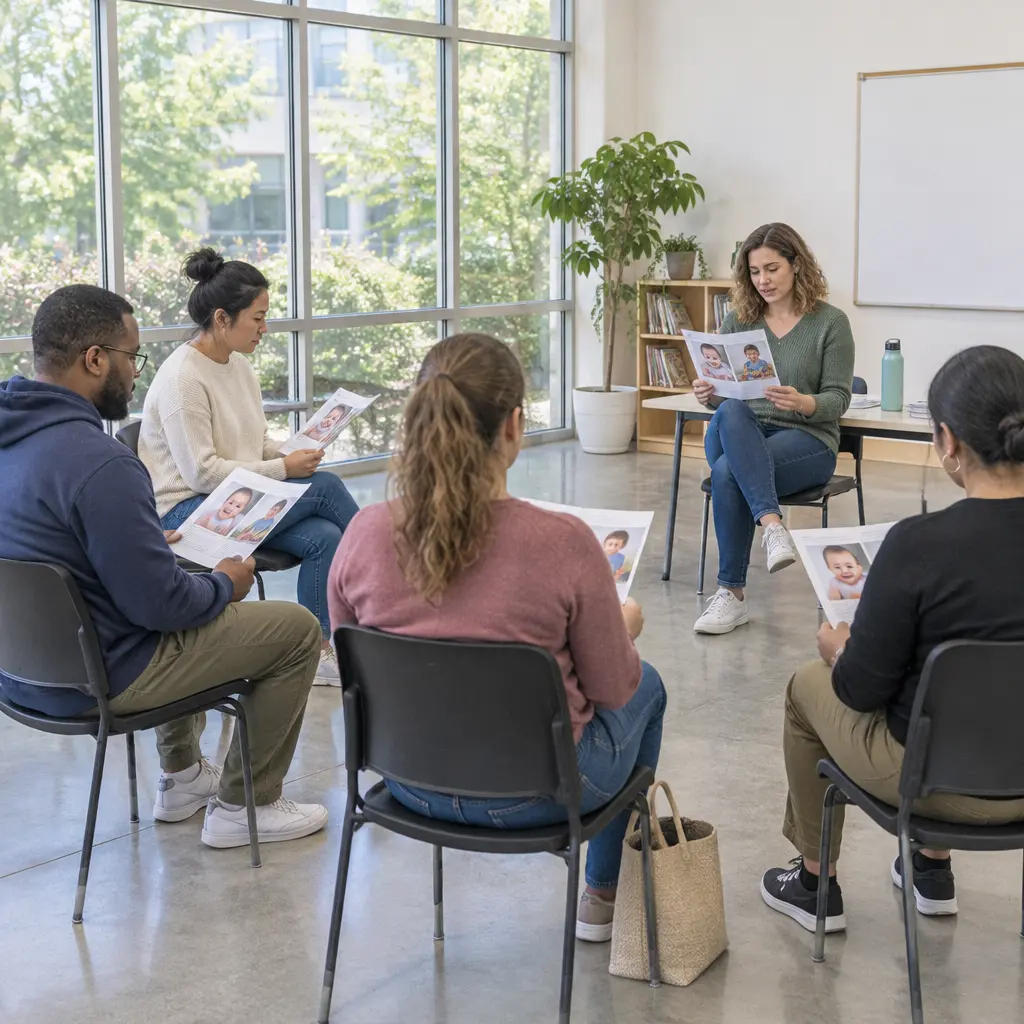
Group classes are scheduled sessions led by an educator, clinician, or trained facilitator. They may address prenatal preparation, newborn care, positive discipline, communication, or transitions such as starting school. A group can normalize common challenges and let participants learn from one another, while a curriculum gives the sessions a consistent structure. Families should check whether a course includes practice, opportunities for questions, and guidance on when to seek individualized help.
A real-world example is the Triple P—Positive Parenting Program, which offers different levels of support, from brief information and seminars to more intensive interventions. This tiered design reflects a practical principle: families may benefit from different amounts of support, and not every caregiver needs the same level of intervention. Program availability and delivery vary by community.
Home Visiting and Family Coaching
Home visiting connects families with trained professionals who provide education, coaching, and referrals in a family-centered setting. Depending on the model, visits may address prenatal health, infant development, safe environments, caregiver-child interaction, or access to community services. Home visitors can tailor discussion to the family’s routines and strengths, although programs differ in eligibility, visit frequency, staffing, and evidence base.
The U.S. Department of Health and Human Services’ Maternal, Infant, and Early Childhood Home Visiting (MIECHV) program funds evidence-based home-visiting services for eligible families. Its annual reports track measures such as maternal and child health, child development, school readiness, and family economic self-sufficiency. These measures show how parenting education can be part of a broader service system rather than a stand-alone class.
Parent-Management Training and Targeted Support
Parent-management training is a structured intervention that teaches caregivers behavioral strategies, such as reinforcing desired behavior, setting clear expectations, and responding consistently to challenging behavior. It is often delivered by trained practitioners and may be recommended when behavior difficulties interfere with family, school, or social functioning. It is distinct from a general parenting workshop because it typically follows a defined protocol and may include individualized goals and progress monitoring.
The CDC notes that parent training in behavior management is a recommended treatment approach for young children with ADHD. Caregivers considering targeted support can ask a pediatrician or mental-health professional about the provider’s training, the intervention’s evidence, and how the program coordinates with school or clinical care.
Online and Hybrid Caregiver Education
Online programs provide lessons, videos, discussion groups, or virtual coaching. Hybrid models combine remote learning with in-person sessions or individualized support. These options may reduce travel and scheduling barriers, but access depends on reliable internet, suitable devices, language accessibility, and privacy. A digital course should make its authorship and evidence clear, offer practical rather than purely promotional advice, and explain when a family should consult a qualified professional.
Remote access can extend a program’s reach, but it is not automatically equivalent to in-person support for every family. Caregivers facing a crisis, developmental concern, or safety issue may need direct assessment and referral. The best delivery model is the one that is accessible, culturally and linguistically appropriate, and sufficiently intensive for the family’s circumstances.
Assess Outcomes, Evidence, and Program Quality
Parenting education outcomes can include caregiver knowledge and confidence, parenting practices, parent-child interaction, child behavior, safety, and connection to services. Results depend on the program’s design, the needs of participants, the quality of delivery, and whether families can attend consistently. No single course is guaranteed to produce the same result for every household, so claims should be judged against credible evaluation rather than testimonials alone.
What Research Says About Parenting Interventions
The World Health Organization’s 2023 report on parenting interventions summarizes evidence that structured programs can improve caregiver-child relationships and reduce harsh parenting and child behavior problems. The WHO recommends interventions that are evidence-based, responsive to children’s developmental stages, and adapted to cultural and social contexts. The findings support offering accessible programs while avoiding the assumption that one format or curriculum fits all families.
Evaluation should distinguish between immediate learning and longer-term outcomes. A participant may report greater confidence after a course, while changes in child behavior or family wellbeing may take more time and depend on other supports. Program reports are most useful when they explain who participated, how outcomes were measured, how long follow-up lasted, and whether results were compared with an appropriate alternative.
Child Development and Prevention Context
The CDC’s estimate that about 1 in 6 U.S. children aged 3–17 had a diagnosed developmental disability during 2009–2017 underscores why caregivers benefit from reliable information about development and early support. The figure includes several types of developmental disabilities and is not a measure of parenting-program need or effectiveness. It does, however, highlight the importance of helping caregivers recognize concerns and discuss them with health and education professionals.
Parent education can support prevention and early response by helping adults understand developmental milestones, communicate with providers, and use supportive practices at home. It should not replace diagnostic assessment, therapy, or medical care when those are needed. A useful course makes its boundaries clear and provides pathways to additional services.
Equity, Cultural Fit, and Access
Program quality includes more than curriculum: families need a realistic way to participate. Transportation, childcare, work schedules, disability access, cost, language, and digital connectivity can all affect attendance. Programs can reduce barriers through flexible scheduling, interpretation, accessible materials, childcare, remote options, and respectful engagement with family culture and structure.
Caregivers should be treated as partners with knowledge of their own children, not as problems to be corrected. A culturally responsive program explains the evidence behind its recommendations, invites questions, and adapts examples without compromising safety or core principles. These features can make learning more relevant and improve the chance that families will use strategies in daily life.
Choose and Access Parenting Classes for Caregivers
Choosing a parenting class or education program begins with identifying the family’s goal. A caregiver preparing for a newborn may need safe-sleep and feeding guidance; a parent concerned about behavior may benefit from structured coaching; and a family seeking general support may prefer a group class or peer program. Matching the service to the need helps avoid expecting a brief class to address concerns that require individualized or clinical care.
Questions to Ask Before Enrolling
Before enrolling, ask who developed and delivers the program, what training facilitators receive, which age groups it serves, and whether its approach has been evaluated. Also ask about cost, language options, accessibility, schedule, confidentiality, and whether the program can connect families with health, mental-health, or social services. A reputable provider should describe its methods and limitations clearly.
- Does the curriculum address the child’s age, developmental stage, and the caregiver’s specific goals?
- Are lessons practical, respectful, and supported by current guidance from credible health or child-development organizations?
- Can caregivers practice skills and receive feedback, rather than only listen to lectures?
- What referral options are available if the family needs specialized support?
- How does the provider protect privacy and make participation accessible?
Where Families Can Find Programs
Families can ask pediatricians, obstetric care teams, schools, public libraries, community health centers, family resource centers, and local social-service agencies about nearby programs. In the United States, the MIECHV program supports home visiting through state and local systems, while community organizations may offer classes or referrals. Availability and eligibility vary, so local agencies are often the best source for current details.
Caregivers can also consult trusted guidance from the CDC, the American Academy of Pediatrics, and the World Health Organization. These organizations provide health and development information, but online reading is not a substitute for individualized advice when a child has a medical, developmental, or safety concern.
Conclusion: Make Caregiver Education Accessible and Evidence-Based
Parenting classes and education programs range from group workshops and home visiting to targeted parent-management training and online learning. Their shared purpose is to strengthen caregivers’ knowledge and practical skills, while evidence and public-health guidance support programs that promote nurturing relationships, positive behavior strategies, and child safety. Research and population data reinforce the importance of accessible developmental information, but program outcomes depend on fit, quality, and sustained support.
Caregivers can take a useful next step by clarifying their goals, asking providers about evidence and accessibility, and seeking referrals when a child or family needs more than general education. Communities and service systems can help by making programs affordable, culturally responsive, and connected to health and social supports. For further reading, consult the CDC, WHO, American Academy of Pediatrics, and the U.S. Department of Health and Human Services’ home-visiting resources.
Sources: World Health Organization, WHO Guidelines on Parenting Interventions to Prevent Maltreatment and Enhance Parent–Child Relationships with Children Aged 0–17 Years, 2022, https://www.who.int/publications/i/item/9789240065505; World Health Organization, Parenting Interventions to Promote Healthy Child Development, Prevent Maltreatment and Improve Parent-Child Relationships, 2023, https://www.who.int/publications/i/item/9789240065505; Centers for Disease Control and Prevention, Data and Statistics on Children’s Mental Health, https://www.cdc.gov/children-mental-health/data-research/; Centers for Disease Control and Prevention, Parent Training in Behavior Management for ADHD, https://www.cdc.gov/adhd/treatment/behavior-therapy.html; American Academy of Pediatrics, Sleep-Related Infant Deaths: Updated 2022 Recommendations for Reducing Infant Deaths in the Sleep Environment, https://publications.aap.org/pediatrics/article/150/1/e2022057990/188304/; U.S. Department of Health and Human Services, Maternal, Infant, and Early Childhood Home Visiting Program, https://mchb.hrsa.gov/programs-impact/programs/home-visiting/maternal-infant-early-childhood-home-visiting-miechv-program; Triple P—Positive Parenting Program, About Triple P, https://www.triplep-parenting.com/usa-en/about-triple-p/